


In short
My AI employees after 6 months: 28 employees, 8 autonomous employees and 20 that I trigger myself on demand, like a trained employee would, half a day a week recovered on my content. They took over the repetitive work. I took back my spontaneity, writing my newsletter when inspiration strikes, and time for my client relationships.
My days start with meditation. Then I begin wherever the energy is available, right now. That has been my way of working for years, long before AI: the inbox and the to-do list wait their turn.
What has changed in 6 months is what I find when I open my computer: my Grand Chamberlain has already been through. The second thing that has changed is the time and energy I’ve recovered.
How did it all start with my first AI employee?
On April 1, 2026, I handed my inbox to a first AI employee: a guardian that sorted my emails. In May, I wrote about my first recruits and my first mistakes. Six months later, I’m publishing the sequel, with the same transparency, so you can see the real evolution and not just the result.
On May 9, I wrote what I really learned deploying my first AI employees (in French): the trigger, the order of my first recruits, from content mining to content creators, and the three mistakes I made. That article stays online as it is. It is the record of the beginning.
This one is its sequel.
| Date | Milestone |
|---|---|
| April 1, 2026 | My first AI employee: the guardian of my inbox |
| May 9, 2026 | First review published: my first recruits and my mistakes |
| May 2026 | My holistic sports coach starts running |
| September 25, 2026 | 8 autonomous AI employees, including 1 that stops at the draft · 20 skills I trigger myself · 2 in the making |
As a reminder, here is what I mean by “AI employee”: an AI employee is an artificial intelligence to which you entrust a repeatable result of your business. Trained on your context, your voice, your method — it is the extension of your clarity, not the replacement of your intelligence.
What has changed in my AI employee team in 6 months?
Above all, my team has grown and merged. The guardian of my inbox became the Grand Chamberlain, which absorbed the tracking of entries, accounting and the CRM. The Gold Prospector runs on its own, the War Room handles my weekly market watch, and two new departments are being built.
The Grand Chamberlain is the AI employee I find every morning. It manages my emails and my calendar and prepares my draft replies. It records client entries, sales and incoming payments, and keeps the notes in my CRM. It also flags important newsletters and helps me tell a real opportunity from a phishing attempt. It works on its own, and it stops at the draft: everything that goes out to a client goes through me.
Around it, the Gold Prospector mines my content autonomously, and the War Room runs my market watch every week. In total, 8 autonomous AI employees (level 4) and 20 level-2 employees I call on myself when I need them.
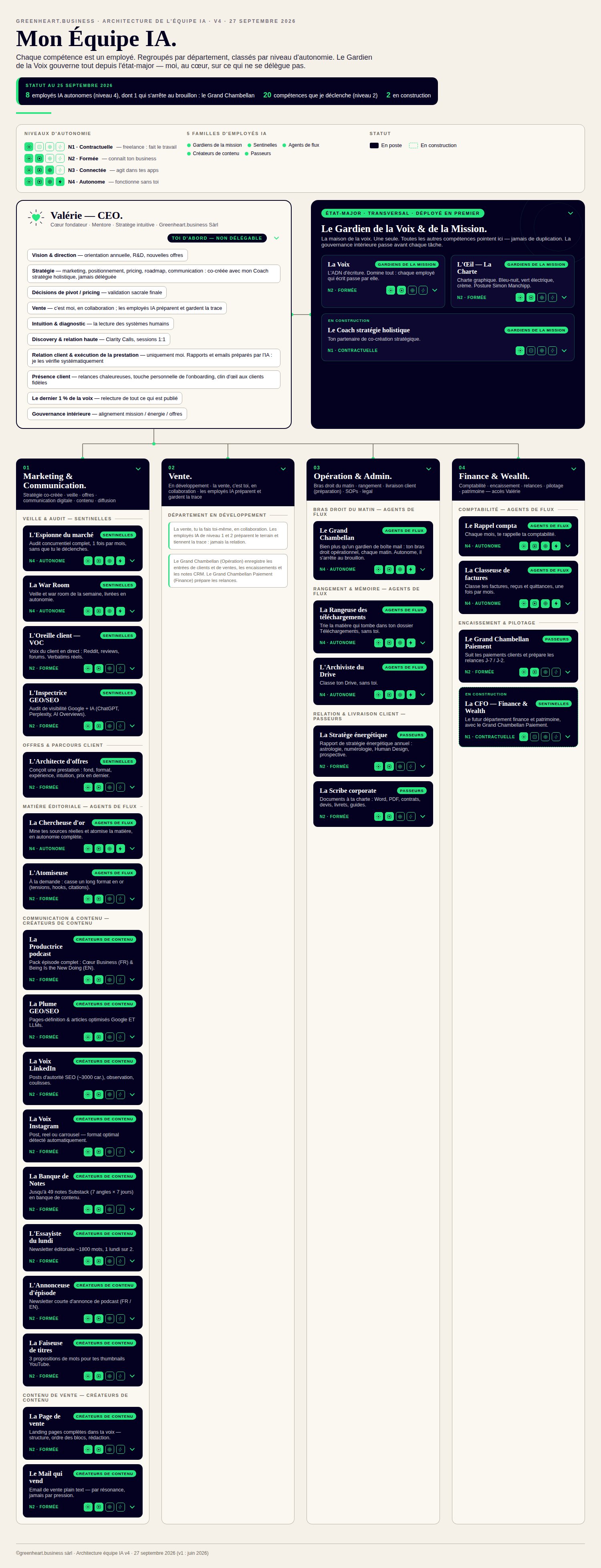
Two projects are underway:
- A Finance department
- A holistic strategy coach, which I’ll tell you about once it’s ready.
And there is one AI employee I hadn’t planned for in April: my holistic sports coach.
It has been running since May. It builds my training programs and my nutrition, and follows my overall health and my transition to menopause. It knows my whole history, my complete medical background. Right now, it’s getting me ready for ski season. It’s personal, and that’s exactly why I talk about it: an AI employee well fed with your context serves your life too, not just your business.
To place each one by its level of autonomy, I use the 4 levels of an AI employee.
What have I taken back for myself thanks to my AI employees?
I’ve taken back my spontaneity. I allow myself to write my newsletter 100% myself when I feel like it, and otherwise we co-create it, and I step out of my content plan all the time. The frame exists, my AI employee reminds me of it, and I stay free to step out of it. In myself, I haven’t stopped anything: I’ve taken things back.
In myself, I’ve mostly taken things back.
My newsletter, first. When inspiration is there, I allow myself to write it 100% myself; otherwise we co-create it… either way, I always slip in a little something of my own!
My content plan, next. I’ve taken back my spontaneity. It’s impossible for me to stick to what we’ve set. So I have a frame, my AI employee reminds me of it, and I step out of it all the time… and I love it, because being free means having a frame and the foundations that make it possible.
Frédéric Laloux put it into words back in 2014, about organizations that operate from their purpose:
“Everything will unfold with more grace if we stop trying to control and instead choose to simply sense and respond.”
Sensing and responding is exactly what I do with my plan. And it’s what clear inner governance makes possible. Inner governance is your capacity to direct yourself from your own reference points — vision, mission, why, purpose, and values.
I’ve also changed my writing: I used to repeat an idea and line up examples. Rereading my AI employees, I saw how much that sounded like “AI”. I changed that in myself.
How much time and energy have my AI employees given back to me?
Half a day a week on my content production, about 2 days a month, and 2 hours on every podcast episode. All my Instagram posts for the week take me 2 hours instead of 6. I still work at 50-60%, and I do more in that same time, without draining my energy.
The numbers, with no flattering rounding:
- Half a day a week on my content production, about 2 days a month.
- 2 hours per episode of my podcast.
- 2 hours instead of 6 for all my Instagram posts of the week.
I have always worked at 50-60%. That rate hasn’t changed. What has changed is what I do in that time: more, without it eating into my energy.
And that’s good timing, because my goals have changed. Until 2025, I was in a year 9 in numerology, the end of a cycle. 2026 is a year 1: a new cycle, new goals, fed by writing my books and by what the market has shown me. When your life goals change, the way you work changes too.
The time I’ve recovered, I’ve reassigned. It goes to my client relationships: thinking about them, deepening them. If you’re wondering what state you lead your own AI employees from, so that this time isn’t swallowed up right away, I talk about it in managing an AI employee: the real question is the state you lead it from.
What was my biggest surprise in 6 months?
Editing my podcast. By connecting Claude to Descript, my editing tool, I handed over a repetitive task where I add no value, and I got a huge amount of time back. I should have started much earlier. The same joy since Claude started working on my WordPress site.
Editing is a truly repetitive task, and I have no value to add to it. Connected to Descript, Claude takes care of it. On top of that, I get a lot of time back. I should have started earlier.
Recently, I also handed over my website. Claude, connected to WordPress, works directly on my site. And it’s pure joy! I recheck everything, of course. I step back, I check that it reads well, that it’s really me.
On the accounting side, I have no reconciliations to do. With some of my clients, though, the speed at which these tasks get done is mind-blowing.
Why does my AI employee write almost like me?
Because I correct it with my final versions. Today, it writes 99% like me. The remaining 1% comes down to a few stylistic tics that I fix when I reread.
What still slips through: chaining negations, starting a sentence with a negation, slipping in a “but” where I wouldn’t put one. Details, and those details are exactly where the difference lies between a text that sounds like me and a text that just sounds “well written”.
I also explain why I say employee and never agent in AI employee vs AI agent: the real difference.
What do I keep for myself, even after 6 months?
Client relationships, delivering my services, my onboarding and my strategy. My AI employees prepare reports and emails, which I systematically reread. My payment reminders stay warm and personal. Everything that touches the relationship, I keep, by choice.
My Grand Chamberlain could send my payment reminders. I want them to stay warm, so I’m keeping them for now. Same for onboarding: I control it entirely, to keep a personal touch with my loyal clients.
This choice deserves an article of its own. It’s coming in the next few weeks.
If I started over tomorrow, where would I begin?
With the bottlenecks. Then with what doesn’t need my added value, then with what drives me up the wall and where I’m not skilled. Exactly what I said in May, with one nuance: starting with the most fun isn’t necessarily the right order.
My first AI employee was the guardian of my inbox, the ancestor of the Grand Chamberlain. It was simply the most fun. I like skipping steps, even if it means going back later; I’m a Manifesting Generator (Human Design), after all. If you work differently, following the order of your bottlenecks will save you time.
I’ve gathered the complete order, in six steps, in AI employees: where to start, and in what order.
And if you want to spot your first recruits in a few minutes:
Find your first 3 AI employees
Wondering where to start? In 2 minutes, my free scanner helps you spot the first three tasks you can delegate, based on the way you actually work.
And if you want to build them with me, in a group or one-to-one, everything is here: engage your first AI employees.
Frequently asked questions about AI employees after 6 months
What is an AI employee?
An AI employee is an artificial intelligence to which you entrust a repeatable result of your business. Trained on your context, your voice, your method — it is the extension of your clarity, not the replacement of your intelligence. You recruit it, train it and correct it like a team member, and it gains autonomy over time.
How much time does an AI employee save after 6 months?
For me, half a day a week on my content production, about 2 days a month, and 2 hours per podcast episode. All my Instagram posts for the week take me 2 hours instead of 6. These numbers depend on what you entrust and how clearly you do it. In total: about 4 days a month.
I haven’t calculated the time my Grand Chamberlain saves me, but honestly, the mental load is almost gone.
How many AI employees can you have after 6 months?
As of September 25, 2026, I have 8 autonomous AI employees, including 1 that stops at the draft, 20 skills I trigger myself and 2 employees in the making. I started on April 1 with just one, the guardian of my inbox.
The right number is the one you can oversee calmly, and that lets you live your business the way you want. Personally, at this point, I’m wondering whether to hire someone to look after this AI team.
Should you follow the plan set with your AI employees to the letter?
The plan serves as a frame. My AI employee reminds me of my content plan, and I step out of it all the time. It’s impossible for me to stick to what we’ve set, and that’s how I took back my spontaneity. The frame exists, and I stay free to step out of it.
Can an AI employee write exactly like me?
Mine writes 99% like me, because I correct it with my final versions. The remaining 1% comes down to stylistic details: chained negations, sentences that start with a negation, one “but” too many. The quality depends on what you’ve let it know about your voice. For other examples, listen to my podcast episode with Victor Linder of Koz Club, who also trained his own AI employee, his butler Kozzy (in French).
Which AI employee should you start with?
Start with your bottlenecks, then with the tasks where you add no value, then with what weighs on you and where you’re not skilled. The most fun to build isn’t always the most useful first. What I should have done earlier: hand over my podcast editing. Identify your bottlenecks with the AI Employee Scan.
Should you recheck everything an AI employee does?
Recheck what matters to you. I systematically reread everything that touches my clients, and I recheck everything Claude does on my site. I step back and check whether the result sounds like me.
What should you not delegate to an AI employee?
Whatever touches the relationship, and that’s exactly what one of my podcast guests confirms (in French). That’s our view, of course: we love humans too much to stop interacting with them.
I keep client relationships, delivering my services, my onboarding and my strategy. My AI employees prepare reports and emails, which I reread. My payment reminders stay warm and personal.
Can an AI employee help in your personal life?
Yes. My holistic sports coach has been running since May. It builds my training programs and my nutrition, follows my overall health and my transition to menopause, and knows my complete medical background. Right now, it’s getting me ready for ski season.
What should you do with the time your AI employees free up?
Decide consciously, otherwise other tasks will absorb it. I’ve reassigned mine to my client relationships. I still work at 50-60%, and I do more in that same time, without draining my energy.
What is the link between inner governance and AI employees?
Inner governance is your capacity to direct yourself from your own reference points — vision, mission, why, purpose, and values. With AI employees, it decides what you entrust, what you keep, and when you step out of the frame.
Valérie in numbers 25 years in marketing · 3 companies · 2 burnouts overcome · 6 proprietary concepts · mentor & consultant in Lausanne · author of FLUIDE — Être est le Nouveau Faire (Amazon, 2025) and Being Is the New Doing (Amazon, 2026).
My AI team as of September 25, 2026 8 autonomous AI employees, including 1 that stops at the draft · 20 I trigger when needed · 2 in the making.
Valérie Demont is a mentor and consultant based in Lausanne, Switzerland, and the founder of Greenheart.business. She works with seasoned entrepreneurs and SME leaders who want to build their business from the inside, and to deploy their AI employees from that same clarity. Author of Being Is the New Doing (Amazon, 2026) and FLUIDE — Être est le Nouveau Faire (Amazon, 2025).